Agriculture
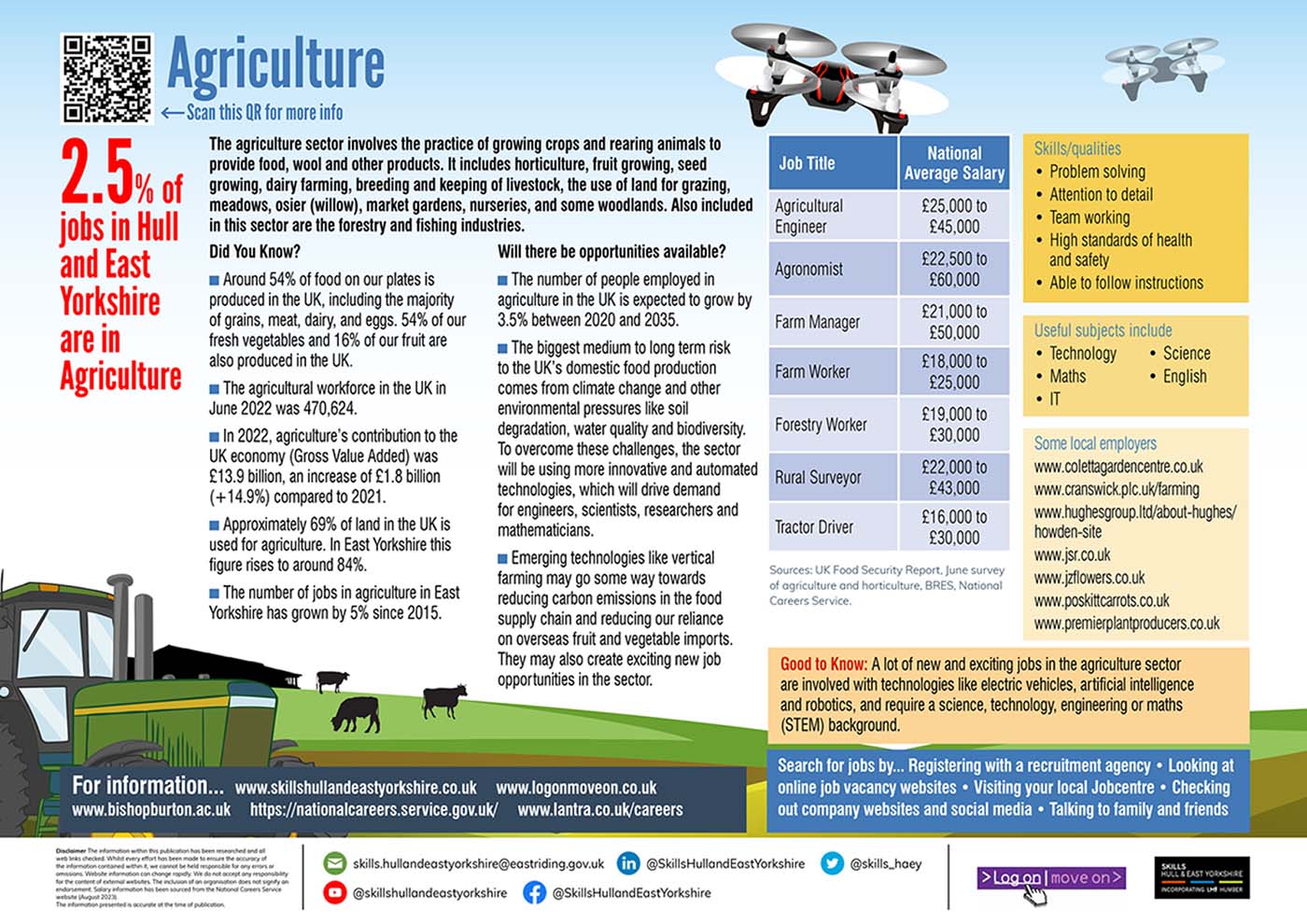
The agriculture sector involves the practice of growing crops and rearing animals to provide food, wool and other products. It includes horticulture, fruit growing, seed growing, dairy farming, breeding and keeping of livestock, the use of land for grazing, meadows, osier (willow), market gardens, nurseries, and some woodlands. Also included in this sector is the forestry and fishing industries.
0
Did you know?
- In terms of employment, agriculture is the ninth-largest sector in Hull and East Yorkshire. Since 2015, the number of jobs with companies in the sector has remained stable, growing by 1.6%.
- In the UK, 69% of the total land area is used for agriculture (16.8 million hectares). In East Yorkshire, this figure rises to approximately 90%.
- The total labour force working on commercial agricultural holdings in the UK in 2025 was 446,196. The labour force in Yorkshire and the Humber made up 29,782 of this total.
- In 2024, agriculture’s contribution to the UK economy was £14.5 billion. This is an increase of £1.6 billion (+13%) compared to 2023.
Source: BRES (2025), East Riding of Yorkshire Council, Defra Survey of Agriculture & Horticulture (June 2025), Defra Agriculture in the United Kingdom 2024 (July 2025)
Will there be opportunities available?
- The East Riding of Yorkshire has the sixth largest agricultural workforce of any local authority area in England.
- Between August 2024 and July 2025, in Hull and East Yorkshire, 80 people started apprenticeships in agriculture, horticulture and animal care subject areas.
- To find out more about careers in agriculture, you could visit Driffield Agricultural Society's annual Countyside Careers Evening.
- The impacts of climate change, biodiversity loss and water insecurity both at home and abroad remain pressing risks to food security. They drive volatility in the present and put sustainability and resilience of food production at risk over the longer term. These risks are also now interacting with heightened geopolitical tensions. Labour and skills shortages in key sectors at home are also a continuing stress factor affecting domestic food production. To overcome these challenges, the sector will likely be using more innovative and automated technologies, which will drive demand for engineers, scientists, researchers and mathematicians to work within it.
Source: Defra Survey of Agriculture & Horticulture (June 2025), DfE Apprenticeships 2024/25, UK Food Security Report 2024
Check out careers in the Agriculture sector in Career of the Week
Find out more
Watch inspirational videos on careers in the Agriculture sector in How Did You Get That Job?
Find out moreVideos
Careerometer
The Careerometer can be used to explore and compare key information about occupations, help you learn about different occupations and identify potential careers. It provides access to a selection of UK headline data relating to pay, weekly hours of work and future employment prospects for different occupations, as well as description of the occupation.
Use the boxes below to simply type in the title of the job you are interested in and the widget provides a series of options from which you can select the most relevant to you. You can then look up another two occupations and compare. You can also select ‘display the UK average’ and compare the information with the occupation you have selected.






Businesses in Your Area
Use the interactive map to discover employers in your local area