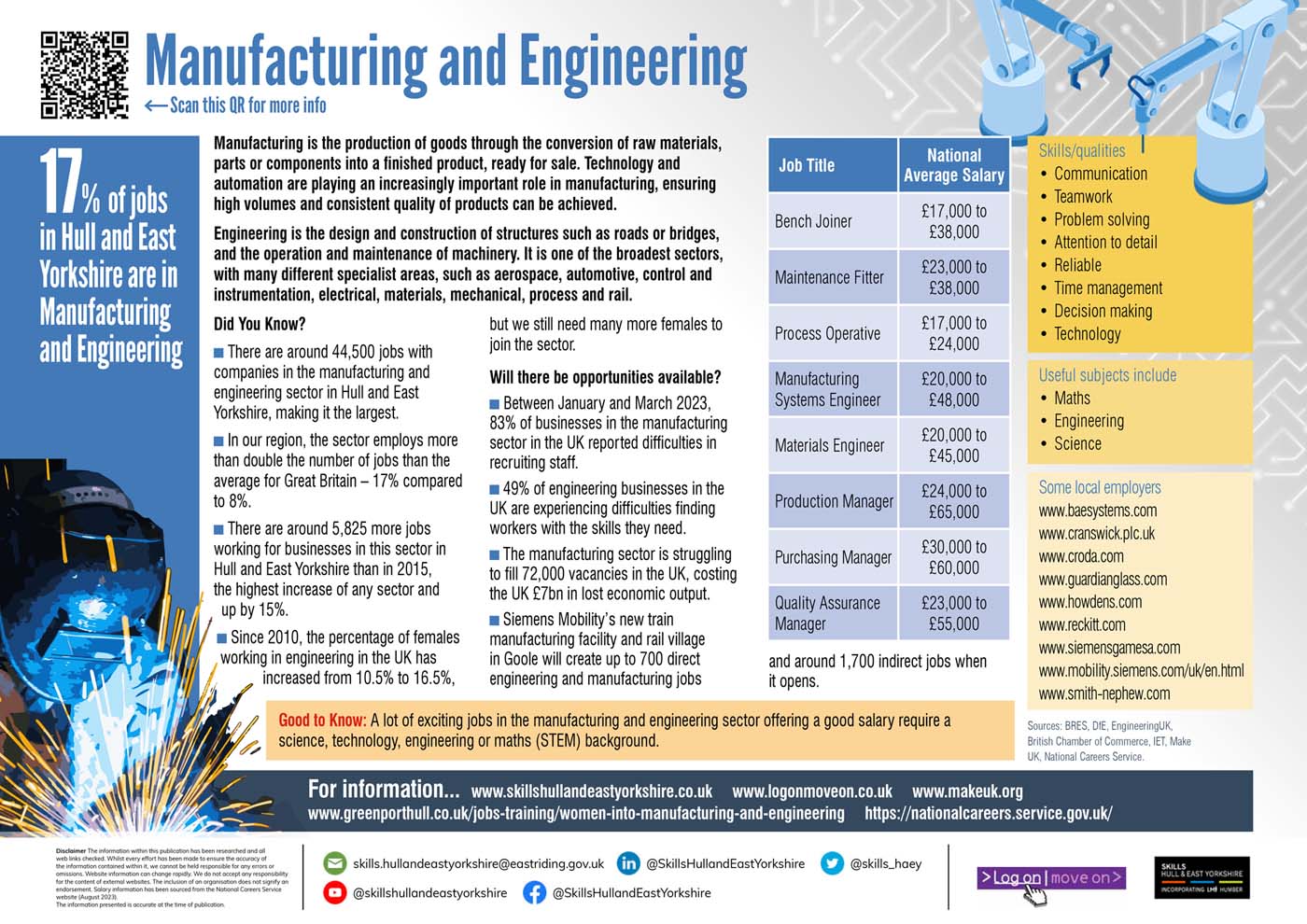
Manufacturing and Engineering
Manufacturing is the production of goods through the conversion of raw materials, parts, or components into a finished product ready for sale. This finished product may be sold directly to the manufacturers’ customers, to wholesalers who will distribute the goods to their customers, or to other manufacturers for use it in the manufacture of their products. Technology and automation are playing an increasingly important role in manufacturing, ensuring high volumes and consistent quality of products can be achieved.
Engineering is the design, construction, use and maintenance of machinery, or structures such as roads or bridges. It involves the application of maths, science and technical knowledge to solve problems. It is one of the broadest sectors, with many different specialist areas, such as aerospace, automotive, control and instrumentation, electrical, materials, mechanical, process or rail.
0
Did you know?
- In terms of employment, manufacturing and engineering is the largest sector in Hull and East Yorkshire. Over 16% of all jobs in the region are in this sector, more than double the national average for Great Britain. Since 2015, the number of people employed by companies in the sector has grown by 13.3%, an increase of 5,155 jobs. The sector has the second-highest growth in job numbers over this period, after the construction sector, and the third-highest percentage growth in employment, after the construction and leisure and tourism sectors.
- Between August 2024 and July 2025, in East Yorkshire, 32% of apprenticeship starts and 33% of apprenticeship achievements were in Engineering and Manufacturing Technologies apprenticeships; over double the average for England.
- In Hull and East Yorkshire, 22% of employment in the manufacturing and engineering sector is in food manufacturing companies (9,560 employees), in particular the production of meat and poultry products (2,100 employees), the processing of meat (2,000 employees), and the manufacture of breads, pastries and cakes (1,700 employees). Significant numbers of people also work for companies involved in manufacturing construction products (7,070 employees), engineering (2,775 employees), pharmaceutical manufacturing (2,010 employees), caravan manufacturing (2,050 employees), kitchen manufacturing (1,535 employees), and turbine manufacturing (1,510 employees).
- Since 2015, the manufacturing and engineering sector companies with the largest increases in employment in Hull and East Yorkshire include those involved in food manufacturing (2,300 additional jobs), turbine manufacturing (1,510 additional jobs), engineering (650 additional jobs), central heating radiator and boiler manufacturing (400 additional jobs), and caravan manufacturing (350 additional jobs).
- Women into Manufacturing and Engineering (WiME) is a local initiative aimed at encouraging more women to pursue careers in these industries.
Source: BRES (2025), DfE
Will there be opportunities available?
- In the UK, in the last quarter of 2025, 75% of manufacturing companies surveyed by the British Chambers of Commerce reported difficulties recruiting staff.
- In 2025, in Hull and East Yorkshire, demand for staff in the manufacturing and engineering sector remained high; there were 1,121 online job adverts for engineering technicians, plant and machine operatives, and packers, bottlers, canners, and fillers.
- Siemens Mobility’s new train manufacturing facility and rail village in Goole has created around five hundred direct manufacturing and engineering jobs since it opened in 2024. By 2027, it is expected to increase this figure to around one thousand direct jobs, with many more generated within the company's supply chain.
- Hull and East Yorkshire benefits from having two Freeport sites in the region - Humber Freeport Hull East and Humber Freeport Goole. Both sites offer incentives for advanced manufacturing businesses to locate there and are expected to contribute significantly to the number of manufacturing jobs in the region in the future.
Source: British Chambers of Commerce, Lightcast (2026)
Check out careers in the Manufacturing and Engineering sector in Career of the Week
Find out more
Watch inspirational videos on careers in the Manufacturing and Engineering sector in How Did You Get That Job?
Find out moreVideos
Careerometer
The Careerometer can be used to explore and compare key information about occupations, help you learn about different occupations and identify potential careers. It provides access to a selection of UK headline data relating to pay, weekly hours of work and future employment prospects for different occupations, as well as description of the occupation.
Use the boxes below to simply type in the title of the job you are interested in and the widget provides a series of options from which you can select the most relevant to you. You can then look up another two occupations and compare. You can also select ‘display the UK average’ and compare the information with the occupation you have selected.
Some local manufacturing and engineering sector employers









Download Manufacturing and Engineering Poster

Businesses in Your Area
Use the interactive map to discover employers in your local area